Select Interview Quotes Without Changing What the Speaker Meant
A short excerpt can communicate one idea clearly, but cutting context can also distort it. Keep a source reference and review the meaning of the edited sequence before publishing.
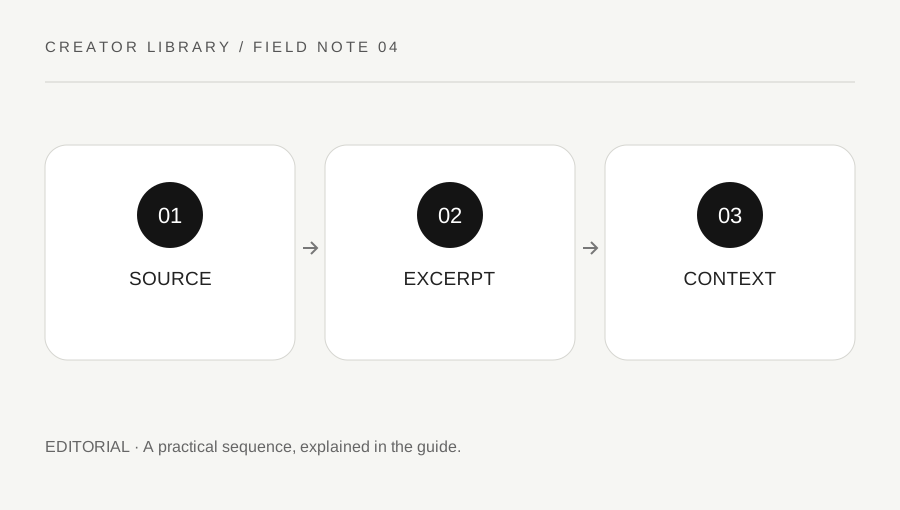
Original explanatory diagram. Examples illustrate a method or decision; they are not claims of personal testing.
Keep a reliable source reference
Retain the authorized interview recording and a timestamped working transcript where appropriate. Mark uncertain words for verification rather than silently guessing. A transcript helps locate material, but the recording remains important for tone, pauses and whether a phrase was interrupted. Use the interview's agreed recording, sharing and retention conditions.
Before selecting a quote, identify the question it answered and any qualification nearby. A sentence beginning with that depends or in this example may require context that sits outside the most dramatic clip. Do not treat a memorable line as a complete position if the speaker was explaining a limited case. Keep private or off-record material out of the selection according to the agreement and applicable process.
Choose a quote for a defined purpose
Write the point the excerpt needs to support. Select a passage that genuinely addresses it rather than rearranging words to fit a prewritten claim. Removing repetition can make an interview easier to follow, but it should not reverse or materially alter the meaning. A transition between separate moments needs careful review so it does not imply a continuous statement that never occurred.
If the production agreement includes a review stage, follow its scope and timing. Clarify whether a review concerns factual accuracy, consent conditions or broader editorial approval rather than assuming everyone has the same expectation. This guide offers a practical editing method, not legal advice about a particular release or an entitlement to use every recorded word.
Work through a conditional statement example
Imagine a speaker says that a method helped their small team under a particular constraint. A clip that keeps only the words the method works can turn a limited observation into a universal recommendation. A better excerpt retains the team and constraint or uses an accurate introduction that supplies the necessary context.
The editor compares the assembled sequence with the source recording and asks what an unfamiliar viewer would infer. If the new sequence suggests a stronger claim than the original, they revise it. The example is hypothetical and does not reproduce a real interview. It illustrates a meaning check that is useful even when every individual word in the cut is technically genuine.
Review text, titles and adjacent images
Check captions and on-screen quote text against the recording. Do not improve wording inside quotation marks without a clear permitted editorial convention. A title, thumbnail or reaction image can also create an implication the speaker did not make. Review the whole presentation rather than treating quote accuracy as a word-for-word check alone.
Keep a short record of the source timestamps and any relevant permission conditions. Prepare an appropriate transcript or other accessible alternative through the publishing workflow, following W3C's media guidance where relevant. If a mistake is found, correct the affected clip and supporting text through the appropriate editorial process. A useful excerpt preserves the speaker's meaning while serving the audience's need for a clear focused explanation.
Keep interviewer additions distinguishable
An explanatory voiceover or caption can help bridge context, but it should be identifiable as the production's wording rather than the interviewee's direct statement. Attribute analysis and uncertainty accurately. If the editor cannot supply a short bridge without making an unsupported inference, choose a longer excerpt or another passage. A slightly less dramatic cut can be more trustworthy and easier to understand than one that depends on the viewer overlooking the missing condition.
A practical checklist
Choices are saved in this browser. Reset them here or clear this site’s browser storage.
Questions that come up
Can genuine words still create a misleading edit?
Yes. Removing conditions or joining separate moments can change what viewers reasonably infer.
Can I rewrite a quote to sound smoother?
Keep direct quotations accurate and use a clearly distinguished paraphrase when appropriate rather than silently changing quoted wording.
Does a transcript replace listening to the source?
No. Verify uncertain words and relevant context against the authorized recording.
References & scope
Background references checked on 18 October 2026. Worked examples and diagrams are original teaching material.