Fact-Check an Explainer Script One Claim at a Time
A clear script can still contain an unsupported statement. Separate factual claims from examples, connect each important claim to an appropriate source and review the wording before recording.
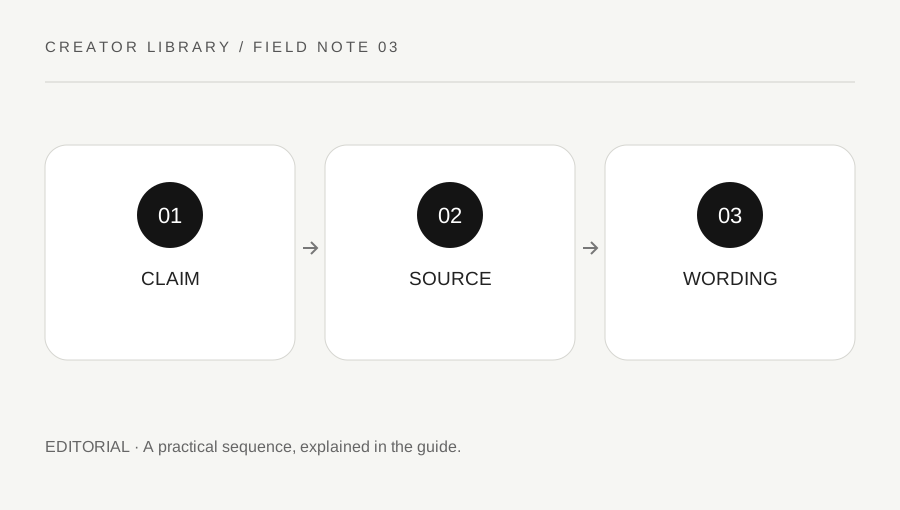
Original explanatory diagram. Examples illustrate a method or decision; they are not claims of personal testing.
Mark the statements that need checking
Read the draft and highlight numbers, dates, definitions, causal explanations and claims about what a product or institution does. Separate these from your own clearly labelled illustrative examples. An invented worked example can be useful teaching material, but it must not appear to be a measured result or a real customer story.
Write each important claim in a small private table with the evidence and the wording it supports. A single paragraph can contain several claims that need different sources. Do not attach one impressive reference to the whole section and assume it validates every sentence. Check what the source actually says and whether its scope matches the script's geography, time and audience.
Prefer sources that directly know the subject
Use official documentation for a product's current behavior, the issuing organization for a policy or report, and appropriate primary research for a scientific question. Read beyond a search snippet when the detail matters. Record the date consulted for information that can change, and distinguish a current instruction from an older archived version.
If a claim cannot be supported, narrow it, qualify it or remove it. Avoid changing may into will or a limited example into a universal rule merely to make the narration punchier. WIPO's guidance on using others' work is relevant to permissions, while it does not establish every factual statement in a script. Match each reference to the specific job it can actually do.
Work through a hypothetical statistics sentence
Imagine a draft says that a tool doubles everyone's productivity. The source is one small demonstration using a particular task. A careful revision describes the demonstration's conditions or omits the broad claim. It does not convert the example into a universal result. The rewritten sentence can still explain what the tool is intended to help with without inventing a guaranteed outcome.
For a numerical worked example, use explicit teaching labels and check the arithmetic. If the values are hypothetical, say so. If they are measured, retain the source, units and denominator. This makes the difference between explanation and evidence visible, allowing viewers to understand the example without mistaking it for a reported real-world performance figure.
Check the final spoken and visual versions
Review narration, on-screen text, captions and description links together. A corrected script can still leave an old number in a graphic or a misleading chapter title. Use one checked claim record as the reference and update every affected asset. Keep the source trail appropriate for viewers without copying excessive text or reproducing material without permission.
For high-stakes medical, legal or financial content, use suitable qualified review and current authoritative information. A general fact-check table is not a substitute for expertise. Before publishing, record unresolved uncertainty and decide whether the content should wait or be narrowed. A useful explainer earns clarity by matching its confidence to the evidence rather than speaking more confidently than its sources allow.
Separate a quote from your summary
If you quote someone, verify the exact words and context and use only the amount you are entitled to reproduce. If you summarize, make clear that the wording is yours and preserve the source's limits. Do not place quotation marks around an improved paraphrase. A polished line can change meaning by omitting a qualification, so compare the final sentence against the original. This check is especially valuable when a short video compresses a long interview or report into a few seconds.
A practical checklist
Choices are saved in this browser. Reset them here or clear this site’s browser storage.
Questions that come up
Does one source validate a whole script?
No. Different claims may need different evidence, and a source supports only what it actually establishes.
Can an example be invented?
Yes, as a clearly labelled teaching example with checked logic and arithmetic. Do not present it as measured evidence.
Should uncertainty be removed for a stronger hook?
No. Keep qualifications that materially affect the meaning and narrow claims when evidence is limited.
References & scope
Background references checked on 18 October 2026. Worked examples and diagrams are original teaching material.